What Is the Difference Between Music and Sound Art?
Sound art is an artistic subject field in which sound is utilised every bit a primary medium or fabric. Similar many genres of contemporary art, audio art may be interdisciplinary in nature, or be used in hybrid forms.
In Western art, early examples include Luigi Russolo's Intonarumori or noise intoners (1913), and subsequent experiments by dadaists, surrealists, the Situationist International, and in Fluxus events and other Happenings. Because of the diversity of sound art, in that location is oftentimes debate about whether sound art falls inside the domains of visual art or experimental music, or both.[1] Other creative lineages from which sound art emerges are conceptual art, minimalism, site-specific art, sound poesy, electro-acoustic music, spoken give-and-take, advanced poetry, sound scenography,[two] and experimental theatre.[iii]
Origin of term [edit]
According to Bernhard Gál's research, the first published employ of the term was establish in Something Else Press on the cover of their 1974 Yearbook.[four] The first use as the title of an exhibition at a major museum was 1979's "Audio Fine art" at the Museum of Modern Art in New York (MoMA), featuring Maggi Payne, Connie Beckley, and Julia Heyward.[5] The curator, Barbara London defined the term thusly, "'Audio art' pieces are more closely allied to art than to music, and are usually presented in the museum, gallery, or culling space."[6]
Later, the art historian Don Goddard would expand on this, writing about an exhibition called "Sound/Art" at The Sculpture Center in New York City in 1984 "It may exist that sound art adheres to curator Hellermann'south perception that 'hearing is some other form of seeing,' that audio has meaning only when its connectedness with an image is understood... The conjunction of sound and paradigm insists on the appointment of the viewer, forcing participation in existent infinite and concrete, responsive thought, rather than illusionary space and thought."[7]
Sound installation [edit]
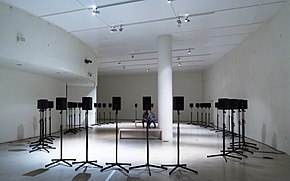
Sound installation is an intermedia and time-based art form. Information technology is an expansion of an fine art installation in the sense that information technology includes the sound chemical element and therefore the time element.[8] The primary difference with a sound sculpture is that a audio installation has a three-dimensional space and the axes with which the different sound objects are being organized are non exclusively internal to the work, but also external. A work of art is an installation only if information technology makes a dialog with the surrounding infinite. A sound installation is usually site-specific, but sometimes it can be readapted to other spaces. It can exist made either in closed or open spaces, and context is central in determining how a sound installation volition be aesthetically perceived. The deviation between a regular art installation and a sound installation is that the latter contains a time element, which gives the visiting public the option to stay longer to explore the development of the sound over fourth dimension. This temporal factor besides gives the audition an incentive to explore the space more than thoroughly and investigate the disposition of the different sounds in space.
Sound installations sometimes use interactive art technology (computers, sensors, mechanical and kinetic devices, etc.), but they can also simply use sound sources placed at different points in infinite (such equally speakers), or acoustic instrument materials such as pianoforte strings played by a performer or by the public (see Paul Panhuysen). In the context of museums, this combination of interactive applied science and multi-aqueduct speaker distribution is sometimes referred to as sound scenography.[9]
Audio structure in sound installations [edit]
- The simplest sound course is a repeating sound loop. This is mostly used in Ambient music-like art, and in this case the sound is not the determinant factor of the fine art piece of work.
- The most used sound structure is the open form, since the public can decide to experience a audio installation for but a few minutes or for a longer period of time. This obliges the artist to construct a sound organization that is capable of working well in both cases.
- There is as well the possibility to take a linear sound construction, where sound develops in the same fashion as in a musical limerick.
Audio sculpture [edit]
Sound sculpture is an intermedia and time-based fine art form in which sculpture or any kind of art object produces sound, or the opposite (in the sense that audio is manipulated in such a way as to create a sculptural as opposed to temporal form or mass). Nearly often sound sculpture artists were primarily either visual artists or composers, not having started out direct making sound sculpture.
Cymatics and kinetic fine art have influenced sound sculpture. Sound sculpture is sometimes site-specific.
Sound Artist and Professor of Art at Claremont Graduate University Michael Brewster described his own works equally "Acoustic Sculptures" as early as 1970.[10] Grayson described sound sculpture in 1975 every bit "the integration of visual form and beauty with magical, musical sounds through participatory experience."[xi]
Audio sculptures with Wikipedia articles [edit]
- Blackpool Loftier Tide Organ
- Bounding main organ
- Singing Ringing Tree (Panopticons)
- A Audio Garden
- Gilt Gate Bridge
Gallery [edit]
-

Harry Bertoia, Textured Screen, 1954
-

The Blackpool Loftier Tide Organ
-
-

-

-

See also [edit]
- Listing of sound art organizations and festivals
- Listing of sound artists
- List of topics related to Sound Fine art
- Acousmonium
- Acoustic ecology
- Work of art
- Audium
- Cassette civilization
- Electronic music
- Fluxus
- Installation art
- Intermedia
- NIME
- Noise Music
- Performance art
- Radio art
- Sonification
- Audio effect
- Sound poesy
- Soundscape
- Video game music
- Visual music
- Audio map
Notes [edit]
- ^ Goldsmith, Kenneth. Duchamp Is My Lawyer: The Polemics, Pragmatics, and Poetics of UbuWeb, Columbia University Press, New York, p. 125.
- ^ Brückner, Atelier (2010). Scenography / Szenografie - Making spaces talk / Narrative Räume. Stuttgart: avedition. p. 209.
- ^ Kenneth Goldsmith, Duchamp Is My Lawyer: The Polemics, Pragmatics, and Poetics of UbuWeb, Columbia University Press, New York, p. 136.
- ^ Gál, Bernhard (December 1, 2017). "Updating the History of Sound Art: Additions, Clarifications, More Questions". Leonardo Music Journal. 27: 78–81. doi:ten.1162/LMJ_a_01023. S2CID 57559930.
- ^ Dunaway, Judy (May vii, 2020). "The Forgotten 1979 MoMA Audio Art Exhibition". Resonance. 1: 25–46. doi:ten.1525/res.2020.ane.1.25.
- ^ "Museum of Modern Art, Museum exhibition features works incorporating sound, press release no. 42 for Sound Art exhibition 25 June–v August 1979". No. Exh. 1266. MoMA Athenaeum.
- ^ Hellerman, William, and Don Goddard. 1983. Catalogue for "Sound/Art" at The Sculpture Center, New York City, May ane–thirty, 1984 and BACA/DCC Gallery June i–xxx, 1984.[ page needed ].
- ^ Ouzounian, Gascia (2008). Sound art and spatial practices: situating sound installation art since 1958. San Diego: UC.
- ^ Brückner, Atelier (2010). Scenography / Szenografie - Making spaces talk / Narrative Räume. Stuttgart: avedition. p. 209.
- ^ "Claremont Graduate University mourns loss of longtime art Professor Michael Brewster". Claremont Graduate University. 23 June 2016. Retrieved 26 September 2021.
- ^ Grayson, John (1975). Sound sculpture : a collection of essays past artists surveying the techniques, applications, and time to come directions of sound sculpture. A.R.C. Publications. p. V. ISBN0-88985-000-iii.
References [edit]
- Kenneth Goldsmith, Duchamp Is My Lawyer: The Polemics, Pragmatics, and Poetics of UbuWeb, Columbia University Press, New York
- Kahn, Douglas. 2001. Dissonance, Water, Meat: A History of Sound in the Arts. Cambridge: MIT Press. ISBN 0-262-61172-4.
- Licht, Alan. 2007. Audio Art: Beyond Music, Between Categories (with accompanying compact disc recording). New York: Rizzoli International Publications. ISBN 0-8478-2969-3.
Further reading [edit]
- Attali, Jacques. 1985. Noise: The Political Economic system of Music, translated by Brian Massumi, foreword by Fredric Jameson, afterword by Susan McClary. Minneapolis: University of Minnesota Press. ISBN 0-8166-1286-2 (cloth) ISBN 0-8166-1287-0 (pbk.)
- Bandt, Ros. 2001. Sound Sculpture: Intersections in Sound and Sculpture in Australian Artworks. Sydney: Craftsman House. ISBN 1-877004-02-2.
- Cage, John. 1961. "Silence: Lectures and Writings". Middletown, CT: Wesleyan University Press. (Paperback reprint edition 1973, ISBN 0-8195-6028-6)
- Cox, Christoph. 2003. "Render to Form: Christoph Cox on Neo-modernist Sound Art—Sound—Column." Artforum (Nov): [pages].
- Cox, Christoph. 2009. "Sound Art and the Sonic Unconscious". Organised Sound 14, no. i:19–26.
- Cox, Christoph. 2011. "Beyond Representation and Signification: Toward a Sonic Materialism". Journal of Visual Culture ten, no. ii:145–161.
- Cox, Christoph, and Daniel Warner (eds.). 2004. Sound Culture: Readings in Modern Music. New York: Continuum. ISBN 0-8264-1615-2.
- Drobnick, Jim (ed.). 2004. Aural Cultures. Toronto: YYZ Books; Banff: Walter Phillips Gallery Editions. ISBN 0-920397-80-8.
- Hegarty, Paul. 2007. Noise Music: A History. New York: Continuum International Publishing Grouping. ISBN 978-0-8264-1726-8 (hardcover) ISBN 978-0-8264-1727-5 (pbk)
- Jensenius, Alexander Refsum; Lyons, Michael, eds. (2017). A NIME Reader: Fifteen Years of New Interfaces for Musical Expression. Springer. ISBN978-3-319-47214-0.
- Kim-Cohen, Seth. 2009. In the Blink of an Ear: Toward a Not-Cochlear Sonic Art. New York: Continuum. ISBN 978-0-8264-2971-i
- LaBelle, Brandon. 2006. Background Noise: Perspectives on Sound Art. New York and London: The Continuum International Publishing Group. ISBN 0-8264-1844-9 (material) ISBN 0-8264-1845-7 (pbk)
- Lander, Dan, and Micah Lexier (eds.). 1990. Audio by Artists. Toronto: Art Metropole/Walter Phillips Gallery.
- Lucier, Alvin, and Douglas Simon. 1980. Chambers. Middletown, Connecticut: Wesleyan University Press. ISBN 0-8195-5042-6.
- Nechvatal, Joseph. 2000. "Towards a Sound Ecstatic Electronica". The Matter.
- Oliveros, Pauline. 1984. Software for People. Baltimore: Smith Publications. ISBN 0-914162-59-4 (cloth) ISBN 0-914162-60-viii (pbk)
- Paik, Nam June. 1963. "Post Music Manifesto," Videa N Videology. Syracuse, New York: Everson Museum of Fine art.
- Peer, René van. 1993. Interviews with Sound Artists. Eindhoven: Het Apollohuis.
- Rogers, Holly. 2013. Sounding the Gallery: Video and the Ascent of Art-Music. Oxford: Oxford University Press.
- Schaefer, Janek, Bryan Biggs, Christoph Cox, and Sara-Jayne Parsons. 2012. "Janek Schaefer: Sound Fine art: A Retrospective". Liverpool: The Bluecoat. ISBN 978-0-9538896-eight-six.
- Schafer, R. Murray. 1977. The Soundscape. Rochester, Vermont: Destiny Books. ISBN 0-89281-455-1
- Schulz, Berndt (ed.). 2002. Resonanzen: Aspekte der Klangkunst. Heidelberg: Kehrer. ISBN iii-933257-86-7. (Parallel text in German and English)
- Skene, Cameron. 2007. "Sonic Boom". The Montreal Gazette (xiii Jan).
- Toop, David. 2004. Haunted Weather: Music, Silence, and Memory. London: Ophidian's Tail. ISBN one-85242-812-0 (cloth), ISBN ane-85242-789-ii (pbk.)
- Valbonesi, Ilari. A.A.A.A.A.A.A. Cercasi Audio Art. ARTE E CRITICA, Event 64, (2010)
- Wilson, Dan. 2011. "Sonics in the Wildernesses – A Justification." The Brooklyn Rail (April)
- Wishart, Trevor. 1996. On Sonic Art, new and revised edition, edited past Simon Emmerson (with accompanying compact disc recording). Contemporary Music Studies 12. Amsterdam: Harwood Academic Publishers. ISBN 3-7186-5846-1 (material) ISBN 3-7186-5847-X (pbk.) ISBN 3-7186-5848-8 (CD recording)
Source: https://en.wikipedia.org/wiki/Sound_art
0 Response to "What Is the Difference Between Music and Sound Art?"
Post a Comment